
Call for articles on topical issues

Call for articles on topical issues
We are currently looking to publish articles on a series of specific themes that we know people are generally very interested in learning more about. This is an invitation to all those interested in writing an article on any of the themes or specific topics listed below to please submit a short abstract on a future article idea. If your abstract is accepted, we will invite you to submit a full length-article to the magazine, which will then be reviewed. Your abstract should be around 150–250 words long, and we wish to have your abstract before November 3rd. / more
Now is the time – A discussion on current sexual misconduct prevention and provider readiness

keywords:
Sexual misconduct / mental health / integrated care / Seek Then Speak
Now is the time – A discussion on current sexual misconduct prevention and provider readiness
Despite many efforts to prevent sexual misconduct, this unwanted behavior persists in private and public spaces. Given the prevalence of sexual misconduct and the likelihood that mental health care providers will be called upon during their careers to support survivors, how prepared are they? / more
Trapped by tranquility: Understanding dependence on benzodiazepines
keywords:
Benzodiazepines / anxiety / Insomnia / Physical dependence / Psychological dependence / Withdrawal
Trapped by tranquility: Understanding dependence on benzodiazepines
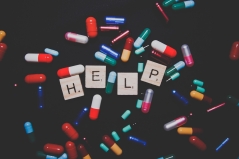
Benzodiazepines offer relief from anxiety and insomnia, yet their calming effects can quietly lead to physical and psychological dependence. This piece explores how that reliance develops and why withdrawal requires support and patience. Recovery is possible when guidance, compassion, and gradual healing replace fear. / more
Negativity Bias: It’s Not All About Evolution!

keywords:
Evaluative Learning / Evaluative Conditioning / Negativity Bias / Positivity Bias / evolution / Information Ecology
Negativity Bias: It’s Not All About Evolution!
Negativity bias refers to the phenomenon that negative information carries more psychological weight than positive information. For instance, the sting of losing $10 is felt more intensely than the joy of gaining $10, and we are quicker to spot a threatening face in a crowd than a friendly one. Surprisingly, however, this effect doesn't seem to show up in evaluative conditioning (which is the change in the liking of a neutral stimulus due to its joint presentation with a positive or negative stimulus)—even when all the typical conditions for it are met. So, why doesn't the bias show up here? We take a closer look at the data to find out. / more
Call for reviewers (In-Mind Magazine): Support In-Mind as a reviewer: Let’s make psychology accessible to everyone!

Call for reviewers (In-Mind Magazine): Support In-Mind as a reviewer: Let’s make psychology accessible to everyone!

What is In-Mind?
In-Mind is a volunteer-driven non-profit project dedicated to sharing psychological research. We present psychological research in an engaging, accessible, and scientifically rigorous way – psychology for all. Our journal publishes freely available articles across all areas of psychology. Visit us at: https://in-mind.org/Who are we looking for?
We are seeking active researchers at all career stages with a passion for... / moreHow do we interpret social situations marked by ambiguity?

keywords:
depression / Social anxiety / interpretations / social situations / ambiguity
How do we interpret social situations marked by ambiguity?
Imagine sending a message to a friend, and hours pass without a reply. Did you do something wrong? Are they upset? Or are they simply busy? Every day, we face moments like these: ambiguous social situations that leave us wondering what others think or feel. How we interpret these moments can shape our emotions, thoughts, social connections, and our own behavior, and can even impact our mental health. In this article, we review recent research from our team that sheds light on how people make sense of such ambiguous social cues, and why some of us tend to interpret them in ways that fuel depression and anxiety. By understanding these distorted interpretation patterns, we can better grasp how mental health disorders develop and persist. / more
Children in front of a screen: what is the impact of technology on their development?

Children in front of a screen: what is the impact of technology on their development?
The use of technology, particularly digital devices, is having a negative impact on children’s psychological and physical development. This is largely due to two factors: today’s generations are growing up in an increasingly digital environment, and parents often allow extensive or unregulated use. In response, the international medical community has put forward recommendations aimed at regulating device use to minimize both short and long-term consequences. / more
Join the In-Mind team: Help us make psychology accessible to everyone!

Join the In-Mind team: Help us make psychology accessible to everyone!
What is In-Mind?
In-Mind is a volunteer-driven project dedicated to sharing psychological research. We give researchers a platform to present their work in an engaging, accessible, and scientifically rigorous way – psychology by scientists, for everyone.
Our journal publishes freely available articles across all areas of psychology. We are the English edition of In-Mind. The journal also publishes in German, French, Dutch, and Italian.
Who are we looking for?
We are seeking active researchers...
/ moreA spoonful of misinformation helps the medicine go viral. How misinformation spreads and who bears the consequences.

keywords:
health misinformation / social media / symptom reporting / online health information seeking / misinformation susceptibility
A spoonful of misinformation helps the medicine go viral. How misinformation spreads and who bears the consequences.
Back to January 2021: you are at home because of the COVID-19 pandemic and decide to scroll through social media for some much-needed distraction. Within seconds, you come across posts about microchips in vaccines, COVID spreading through 5G networks, and President Trump suggesting that injecting disinfectants could be a cure for COVID-19. Social media has become a hotbed of armchair experts, doom-mongers, and conspiracy theorists. You laugh off the misinformation easily, after all, nobody really believes this... Right? / more
A step-by-step guide to writing science communication articles
keywords:
Science communication / Research / In-Mind
A step-by-step guide to writing science communication articles
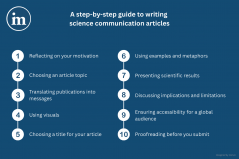
Effective science communication bridges the gap between science and society. This guide outlines practical strategies for turning psychological research into engaging, accessible articles, including topic selection, structuring the article, and responsible presentation of results. / more